


ARTWORK INTERVIEW ARTIST
JONAS LUND |
THE FUTURE OF LIFE
17 NOVEMBER 2024 — ONGOING
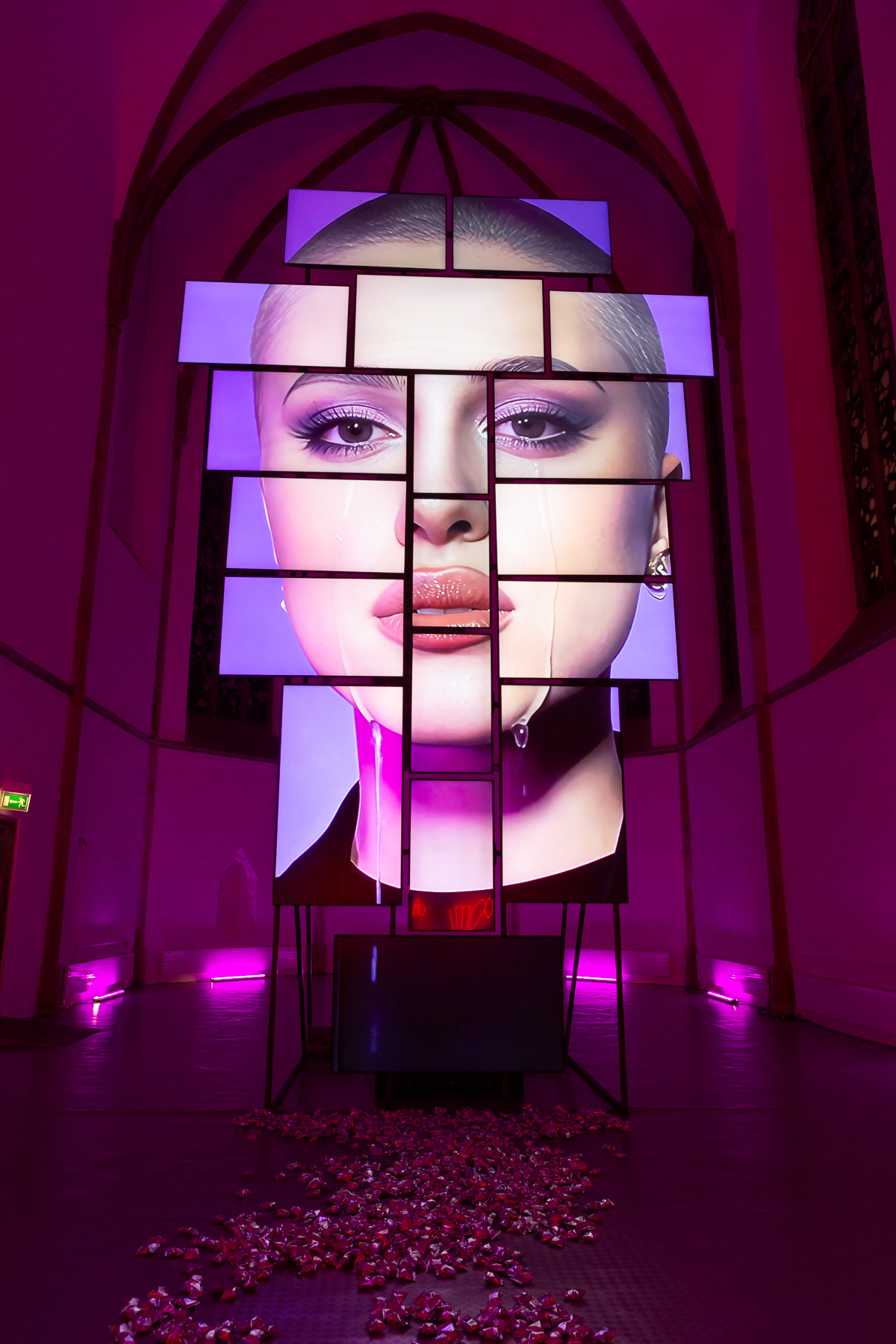
The Future of Life
2024
AI animation (colour, sound), MP4
28 min 02 sec
2352 x 1470px
Edition of 5 + 1AP
(JLun020.24)
ABOUT THE ARTWORK
The Future of Life (2024) imagines an uncanny world where one can live forever through the power of AI. Pushy corporate types from a commercial entity intone about their products that promise to “supercharge your life” and will “shape the world to our desires.” AI will make all the decisions for us so that we can enjoy immortality. Resembling a subverted reality TV show, the narrative unfolds as users of this speculative technology share their unsettling and thought-provoking experiences with it.
The latest in Lund’s series of documentary style videos made with generative AI, this work explores concepts of agency in a world in which we as individuals seem to be more and more reliant on technology provided by faceless tech corporations. The Future of Life taps into our societal anxieties around AI and fear of what might happen should Big Tech go unchecked and unregulated, allowing corporations to exert their commercial interests to all aspects of contemporary life. Through the artistic use of the very AI technology that has become ubiquitous, Lund shows us a world where late capitalism is taken to extremes. The technology of AI is unseen – it seems only to exist somewhere in the ether. Here, Lund makes visible something that is normally invisible. The stilted, blurry figures, for all their ghoulishness, are quite comprehensible and real.
Just as 19th century audiences initially believed that the ‘camera never lies’, so to in the age of AI we are presented with a new and complex version of the real. It seems all too plausible that conversations like this are going on all the time in Big Tech. However, like much of Modernist art before it, Lund’s work ultimately raises more questions than answers.
For all sales enquiries, please contact Annka Kultys at
+44 74 555 61 887 (WhatsApp) or at annka@annkakultys.com (email)
INTERVIEW

How does the pursuit of immortality through AI change our understanding of what it means to be human?
The pursuit of immortality through AI is indeed a quintessentially human endeavor, reflecting our age-old desire to transcend our mortal limitations. It’s the ultimate expression of capitalism’s endless growth mentality – extending not just markets, but human existence itself. This pursuit reveals our complex relationship with mortality: some find peace in life’s finitude, others seek eternal continuation. The Buddhist approach of present-moment harmony offers a compelling alternative to this relentless striving. Ultimately, AI-driven immortality forces us to confront whether being human is defined by our limitations and impermanence, or by our ceaseless ambition to overcome them.
In a world where AI makes all our decisions, what becomes of free will and personal responsibility?
The prospect of AI making all our decisions is dystopian, yet eerily familiar. We’re already living in a world where algorithms significantly shape our preferences, desires, and worldviews. The transition to AI governance might seem like a small step from here. However, this shift would fundamentally alter our concept of free will and personal responsibility. While it’s tempting to view AI as a “neutral” decision-maker, we must remember that AIs inherit biases from their creators and training data. The illusion of AI objectivity could mask a new form of control, potentially more insidious than current power structures. Personal responsibility might evolve into
collective responsibility for the AI systems we create and maintain.
How might the commodification of eternal life exacerbate existing social and economic inequalities?
The commodification of eternal life represents late-stage capitalism taken to its extreme logical conclusion. It would likely create a stark divide between those who can afford immortality and those who cannot, exacerbating existing inequalities to an unprecedented degree. This scenario painfully highlights the absurdity of our current economic system – where even if immortality were achievable, it would remain out of reach for most due to financial constraints. The prospect of “paying rent forever” underscores how our economic structures are ill-equipped to handle such a fundamental shift in human existence. This commodification of life itself could lead to a society where economic class determines not just quality of life, but quantity of life as well.
If you could choose one technological invention from the past or future to live without, what would it be and why?
Teleportation, obviously.
ARTIST INFORMATION
Jonas Lund is interested in the power dynamics framing the increasing digitalisation of contemporary culture. Working across painting, sculpture, photography, digital environments and performance, he builds systems that examine conditions of labor, agency, and authorship within automated collaborative processes. Lund engages with emergent AI models as a co-creator within his narrative worlds, provocatively blurring the line between human and machinic intelligence. Within his multilayered projects, the artist speculates on how this entwined relationship might play out within both the art market and broader social-financial systems.
Born in Linköping, Sweden, and currently based between Amsterdam and Berlin, Jonas Lund (b. 1984) earned his MA at Piet Zwart Institute, Rotterdam (2013) and his BFA at Gerrit Rietveld Academy, Amsterdam (2009).
Recent solo presentations include Annka Kultys Gallery, London (2023), Office Impart, Berlin (2023), Studio Visit: How to Make Art in the Age of Algorithms, Francisco Carolinum, OÖ Art, Linz (2022), König Galerie, König Digital, Berlin (2021), The Photographers’ Gallery (2019), Whitechapel Art Gallery, London (2016), Steve Turner, Los Angeles (2016, 2015, 2014), Växjö Konsthall Sweden (2016), Showroom MAMA, Rotterdam (2013), and the New Museum, New York (2012). Lund has undertaken prestigious residencies and commissions from institutions including the Mozilla Foundation (2021), Lima Collection, Amsterdam (2016), The Moving Museum, Istanbul, Turkey (2014), Mondriaan Fonds (2014), and Eyebeam, New York (2012-2013).
Lund’s work has been included in numerous group exhibitions including Centre Pompidou, Paris, Schinkel Pavillon, Berlin, MAXXI, Rome, HeK Basel, ZKM, Karlsruhe, Vienna Biennale, Witte De With, Rotterdam, Kindl – Centre for Contemporary Art, Berlin, Rhizome, New York, and the Stedelijk Museum, Amsterdam. The artist has been featured in international art publications including Artforum, Frieze, Kunstforum, The New Yorker, The Guardian, Metropolis M, Artslant, Rhizome, Huffington Post, Furtherfield, Wired and more.