


ARTWORK INTERVIEW ARTIST
ZIYANG WU |
PIGEON LEGEND – STORIES 100 YEARS AFTER AGARTHA
18 JANUARY 2026 — ONGOING
Pigeon Legend – Stories 100 Years After Agartha
2024
AI-generated digital video (colour and sound), MP4 (Midjourney, Runway ML Gen3)
1920 x 1080 px
5 min 19 sec
Edition of 5 + 2 AP
(ZWu007.24)
USD 7,000 (exc. VAT)
ABOUT THE ARTWORK
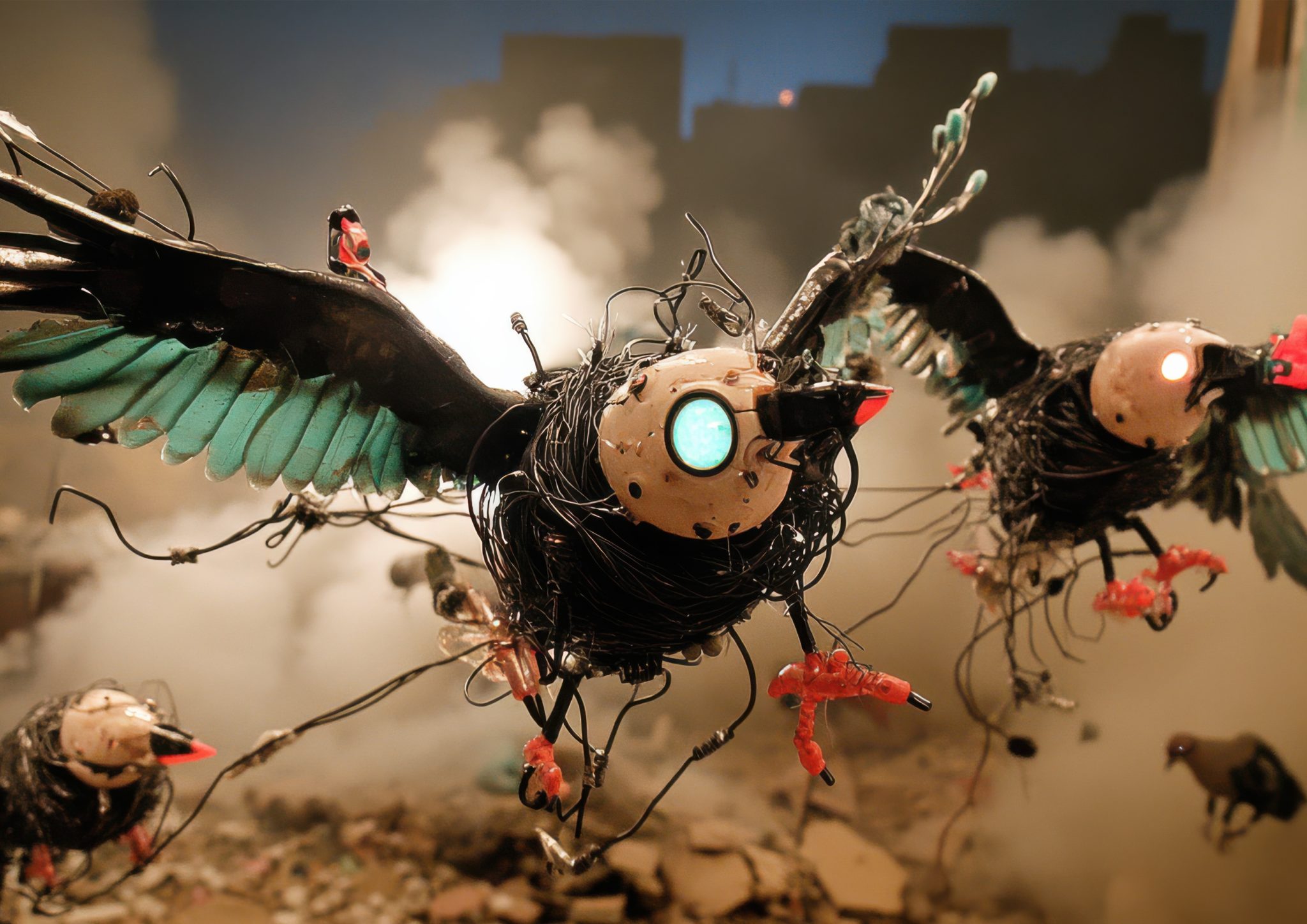
Pigeon Legend-Stories 100 Years After Agartha is the sequel to Agartha. Beginning with the “Dark Connection Laboratory”, this work uses multiple narratives to explore the role of the “Internet Pigeon Network” in future network infrastructure, its connection to communication systems, and the various identities pigeons have held throughout human history — as spies, messengers, ecological guardians, and even cigar smugglers or “flying rats”. In the following 100 years, Patch — great-grandson of Agartha’s protagonist Lien and a hybrid carbon-silicon archaeologist — redefines the meaning of pigeons, revealing their mysterious fate: they are either deified, shot down, or turned into soup. Patch transmits his findings back to Agartha 100 years earlier, while also archiving them for future generations, in hopes that future archaeologists will extend the legend. This work presents the pigeons’ mystery and uncertainty across time andspace — heroes, criminals, keen-eyed observers, power pills, scoundrels, saints, infiltration tools, anti-drone technology, silicon-based emissaries, AI garbage, or perhaps something even more incomprehensible. Pigeons become a complex symbol, intertwining elements of war, history, AI archaeology, technology, and dark humor.
For all sales enquiries, please contact Annka Kultys at
+44 74 555 61 887 (WhatsApp) or at annka@annkakultys.com (email)
INTERVIEW
What are the themes or messages you hope to convey through your work?
Pigeon Legend – Stories 100 Years After Agartha is an integral part of my larger project, Agartha, developed over the past year and commissioned by PinchukArtCentre for the Future Generation Art Prize 2024 in Kyiv, Ukraine. Unlike my earlier works focused solely on specific aspects of algorithmic control, identity politics, or technology-related geopolitics, this piece reflects on the theme of connection and disconnection from a broader, more macro perspective.
It explores how various forms of links—whether biological, technological, or social—shape our interactions and existence in a rapidly changing world. By examining the alternative infrastructures that emerge in the face of intimacy, opacity or even disconnection, I aim to challenge conventional models of communication and connection, offering new possibilities for how different species, technologies, and systems might coexist and interact in a world that emerges through diverse, accidental, and sometimes flawed connections, forming its unique existence.
Why does digital art matter?
Digital infrastructure shapes every aspect of modern life, from politics and military to economics and national power. As a former painter, I realized that (at lease for myself) merely “depicting” images wasn’t enough to confront the profound influence of technology. I had to immerse myself in technological fields, engaging with corporate power, engineers, and startups to critically address these forces. However, I also reject superficial uses of digital tools that just create spectacles, as they replicate outdated production logics without challenging the systems of technological hegemony that dominate our world. Thus, I’m not certain if digital art itself truly matters, but I know that confronting, engaging with, resisting, coexisting with, and questioning technological revolutions and hegemonies undeniably matters.
If you could choose one technological invention from the past or future, what would it be and why?
Telegraph. Before the telegraph, time was fragmented, with each region following its local solar time. Communication depended on transportation, and information could only travel as fast as goods or couriers. The telegraph changed history by decoupling communication from transport, enabling near-instant information exchange and unifying human time for the first time. It standardized “public time,” and laid the foundation for modern global systems like futures trading. This profound connectivity reshaped society. While the internet amplified this legacy, its rise has also introduced unprecedented control, manipulation, addiction, and extreme negative consequences nowadays.
ARTIST INFORMATION
Ziyang Wu was born in 1990 in Xuzhou, China and lives and works in New York, USA.