



PRESS RELEASE INSTALLATION VIEWS ARTWORKS ARTIST INFORMATION
PRESS RELEASE
Annka Kultys Gallery is delighted to announce Qwen Stephanie Against Techfascism, an exhibition from !Mediengruppe Bitnik presented across the gallery’s virtual space launched in 2022. Across four moving image works, the exhibition continues the collective’s interrogation of the unequal systems of power and control inherent on the internet through sermons on technofascism delivered by the fictional character Qwen Stefani, introducing us to a blueprint to resistance. Qwen Stephanie Against Techfascism marks !Mediengruppe Bitnik’s second exhibition with the gallery and coincides with Annka Kultys Gallery’s eleventh anniversary.
!Mediengruppe Bitnik is a contemporary artist duo comprising Carmen Weisskopf and Domagoj Smoljo who live and work in Berlin, Germany. They work both on and with the internet, with their practice crossing over from the digital to affect physical spaces, often intentionally employing loss of control to challenge established structures and mechanisms. This exhibition builds on Annka Kultys Gallery’s collaboration with the artists, following the five-channel video installation Are You Online Now?, exhibited from October–November 2017. Furthermore, it reflects the gallery’s more than decade-long dedication to digital, new-media and technology-engaged artistic practices, cemented by the introduction of Annka Kultys Phygital in 2022, a hybrid virtual-reality space that offers digital artists more experimental areas for display.
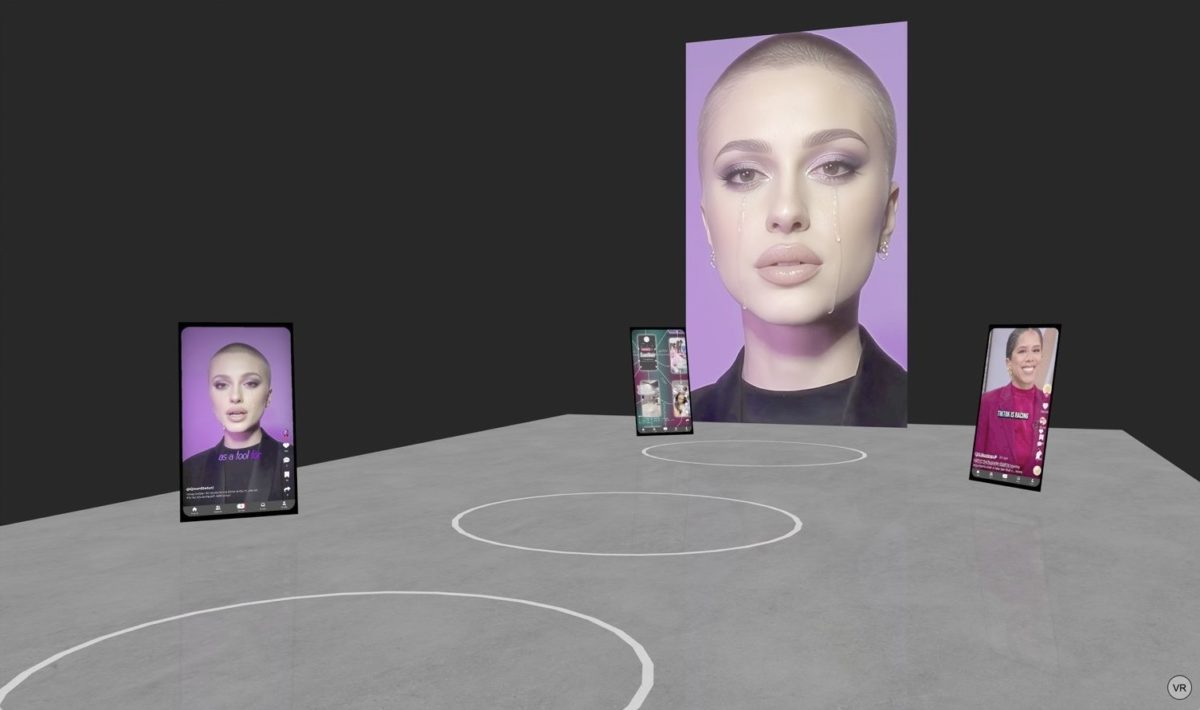
The four sixteen-minute video works, presented as an installation both in the gallery’s physical space and VR counterpart, come from !Mediengruppe Bitnik’s series Qwen Stephanie Against Techfascism (2025-ongoing). Associate Professor Catherine D’Ignazio at Massachusetts Institute of Technology defines technofascism as the increasing collusion between the tech companies of Silicon Valley and right-wing billionaires with anti-democratic political agendas, thereby directly undermining multiracial democracy, human life, and the planet.[i]It is precisely these themes which run throughout the works on show in this exhibition, tackled by Qwen Stefani, an uncanny AI generated character who looks out to us from beyond the screen. Her feminine features mirror the beauty aesthetics that have become so prominent in popular culture: big, bright eyes, plump lips, and a soft, hypnotising American voice.[ii] As she speaks she is perpetually crying, perhaps mourning the loss of our personal freedoms. She is both uncomfortable yet captivating, an archetype of feminine mourning that reaches back through history to the image of the Madonna. Her lectures are punctuated with short video clips which recall the compulsive act of ‘doomscrolling’, incessantly flicking through content online, never staying with one thing for more than a few seconds.[iii] !Mediengruppe Bitnik, however, deftly turn this practice on its head. The videos are not arbitrary but come from the accounts of other digital artists and theorists that they admire, reimagining doomscrolling as an unexpectedly productive form of engagement.
The first video encountered in the exhibition is part one of three of Doomscroll against Techfascism #SabotageManual #AI #TechTok #Qwenstefani (2025). We are lulled into the repetitive act of scrolling through reels, with their competing sounds and images, before being abruptly interrupted by Qwen Stefani, dressed smartly in black against a purple background. “Thank you so much for coming!” she declares, the tears that continually roll down her cheeks at odds with the joy in her voice at our arrival in this digital meeting place. She introduces herself as a ‘tech-critical provocateur’, who uses her viral online presence and pop-star beauty aesthetics to expose the dangers of algorithms and AI-driven authoritarianism. It is in this video that we become familiar with !Mediengruppe Bitnik’s main thesis, that tech billionaires such as Elon Musk have more power than elected officials, while companies such as Facebook, Google, Palantir and OpenAI profit from censorship and anti-democratic practices through their abuse of the data perpetually collected from us. Data, rather than religion, has become the ruling force in society.[iv] As once humans submitted to the authority of a divine being, AI is its contemporary replacement. This parallel is superbly underlined in the video, Qwen’s sermons come not from behind a pulpit, but from within a social media feed.
“I am not Gwen. I am Q. W. E. N.”, proclaims our digital minister in part two. Creating such a distinction may seem strange, considering the obvious allusion to nineties pop icon Gwen Stefani in the exhibition’s protagonist’s name and appearance. However, this link deliberately draws out one of the work’s key narratives and continues the religious theme developed in the previous video. Here, we are introduced to the troubling case of Hallow, one of the world’s most popular Christian prayer apps, developed with investments from conservative political figures such as Peter Thiel and J. D. Vance. Hallow is marketed as offering community, faith and peace, but the artwork instead argues that it collects and then sells valuable personal data including prayer history and emotional states. In 2025, the app became embroiled in controversy as the real-world Stefani faced their advertising campaign, her progressive image clashing with its conservative values. The case study allows Stefani’s crying digital counterpart to draw attention to the ways technologies use harvested data to make predictions about our behaviour and futures, and how algorithms trained on data can increasingly shape decisions made about us. As Claudia Aradau and Tobias Blanke argue, algorithmic systems increasingly redraw boundaries and distinctions between people, determining how individuals and groups are understood and governed.[v] Interwoven with Qwen’s lecture are video reels from artists investigating ways in which technology can be hacked and disrupted.
In part three, Qwen introduces us to !Mediengruppe Bitnik’s blueprint for resistance: the Simple Sabotage Field Manual. Created during World War Two, the manual offered instructions for citizens to disrupt fascist regimes through simple, everyday obstructions designed to slow down the wider economy. Staring directly at us through the screen with her bright eyes, Qwen delivers a call to action for acts of simple sabotage to beat technofascism and reclaim our humanity. These include corrupting databases, circumventing paywalls by sharing account details, leaking publicly important information accidentally, scrolling social media at work and not at home, and unplugging internet cables. Perhaps most poignantly, she asks us to “cry on zoom… especially when it is inappropriate”, bringing us full circle to her own state of tearfulness. There is, of course, an irony inherent in being preached to about the dangers of technology by an AI-generated character, but this is precisely the point. Qwen is named after the Chinese Generative AI platform with which she was created, QWEN.AI. Her likeness was generated by a single prompt to create an image of the woman called Qwen Stefani, crying. Despite such limited information, the Chinese platform created an image deeply embedded with Western feminine beauty standards, drawing stark attention to the biases contained within the data on which generative AI is trained.
The final and largest work of the exhibition is Qwen Stefani Endlessly Crying
(2025), which differs in composition from the others. Here, Qwen no longer delivers her sermons but stares out in close up. Her uncanny silvery tears pour like waterfalls and yet one can’t look away. The silence is punctuated by glitchy, digital sounds as the calls to action of Doomscroll against Techfascism #SabotageManual #AI #TechTok #Qwenstefani (2025) reverberate eerily in the distance. It is perhaps the most uncomfortable and melancholic of the series, there are no other videos, no distractions, just us and Qwen, both trapped in our screens in differing ways.
Through the engaging presence of idealised influencer Qwen Stefani and the accessible social media reel format, across the four videos in this presentation !Mediengruppe Bitnik call the audience’s attention to the increasing consolidation of state and technological power. This reflects Verwiebe and Hagemann description of the rise of a new ‘digital elite’, as those who control increasingly valuable technologies gain greater social and economic power, bringing them into direct alliance with established ruling classes.[vi]
“I know, it’s all a bit much”, says Qwen in the first video of the presentation. However, this is not a dystopian exhibition. Instead, the works celebrate collaboration and collective action: first, by foregrounding the artworks and theories of other artists through a positive form of doomscrolling, and second, by offering an optimistic blueprint for collective resistance. Such a call to action reminds us that we are not simply products or a data points, but instead the creators of the future – and that future can be a more equitable one. Qwen Stephanie Against Techfascism comes at a moment of heightened anxiety and debate around the ever-encroaching role of AI and algorithms, and the growing power of tech billionaires in contemporary society.
—
!Mediengruppe Bitnik’s work has been exhibited in many major international institutions, including Palais de Tokyo, Nam June Paike Art Center, Shanghai Minsheng 21st Century Museum, City Art Gallery Ljubljana, Kunsthaus Zürich, NiMk Amsterdam, Space Gallery London, Cabaret Voltaire Zurich, Beton7 Athens, Museum Folkwang Essen, Contemporary Art Center Vilnius, La Gaîté Lyrique Paris and HEK Basel.
They have received awards including: Swiss Art Award, PAX Art Award, Prix de la Société des Arts Genève, Migros New Media Jubilee Award, Golden Cube Dokfest Kassel, Honorary Mention Prix Ars Electronica.
In 2024, !Mediengruppe Bitnik co-founded the non-profit foundation Error 417 Expectation Failed, supporting experimental internet art and net-based practices that critically engage with contemporary technology. In 2025, the foundation funded 13 projects presented in the online exhibition 13 Scores Against Tech Fascism, alongside two curatorial initiatives through its Error 415 Unsupported Media Type programme. Its 2026 open call, Error 406 [NETSTALGIA] Not Acceptable, turns to the politics of internet nostalgia and the longing for a mythic ‘old internet’.
Current and upcoming exhibitions and projects include Archive Futures / Future Archives, Kunstverein Tiergarten, Berlin (2026); random / random, accès)s( Festival #26, Billère (2026–27); 21.0 × 29.7 cm: Works on DIN A4, Kunsthaus Langenthal, Langenthal (2026); and Ignore All Previous Instructions, Akademie Schloss Solitude Web Residency No. 22, Stuttgart (2026).
Recent exhibitions include solo exhibition Computer Says No, Kunsthalle Osnabrück, Osnabrück (2025–26); GOGBOT 2026 Festival for Art, Music, Technology, Grote Kerk, Enschede (2026); Negotiating the Real – The Desire to Believe, Ars Electronica Festival, Linz (2026); Zero 10: The Condition, Art Basel, Basel (2026); Pling! Sound and Design, Museum für Gestaltung Zürich, Zurich (2026); FUTURE MANIFESTOS, 9th Trondheim Biennale for Art and Technology, Trondheim (2026); and Mehr Licht. Video in der Kunst, Kunstmuseum Solothurn, Solothurn (2026).
By Georgia Gerson
[i] Catherine D’Ignazio, “What Is Technofascism?,” Data + Feminism Lab, MIT, February 4, 2026, Medium, https://medium.com/data-feminism-lab-mit/what-is-technofascism-20697b66c20b
[ii] Sophie Bishop, “YouTube Anxiety: Affect and Anxiety Performance in UK Beauty Vlogging,” in Affect and Social Media: Emotion, Mediation, Anxiety and Contagion, ed. Tony D. Sampson, Stephen Maddison, and Darren Ellis (Bloomsbury Publishing USA, 2018).
[iii] Akat, Muhammed, and Erdal Hamarta. 2025. “Doomscrolling and Social Media Addiction in Adolescents: A Two-Wave Longitudinal Study.” Journal of Addictive Diseases 43 (4): 377–85.
[iv] Roland Verwiebe and Steffen Hagemann, “Bourdieu Revisited: New Forms of Digital Capital – Emergence, Reproduction, Inequality of Distribution,” Information, Communication and Society (May 2024): 1-23.
[v] Claudia Aradau and Tobias Blanke, Algorithmic Reason: The New Government of Self and Other (Oxford: Oxford University Press, 2022).
[vi] Roland Verwiebe and Steffen Hagemann, “Bourdieu Revisited: New Forms of Digital Capital – Emergence, Reproduction, Inequality of Distribution,” Information, Communication and Society (May 2024): 1-23.
INSTALLATION VIEWS
ARTWORKS
!MEDIENGRUPPE BITNIK
Doomscroll against Techfascism #SabotageManual #AI #TechTok #Qwenstefani
2025
3-part video installation, Full-HD, sound, loop.
16 min 06 sec each
Aspect ratio 9:16
(!MGRUP002.25)
The first video, is part one of three of Doomscroll against Techfascism #SabotageManual #AI #TechTok #Qwenstefani (2025). We are lulled into the repetitive act of scrolling through reels, with their competing sounds and images, before being abruptly interrupted by Qwen Stefani, dressed smartly in black against a purple background. “Thank you so much for coming!” she declares, the tears that continually roll down her cheeks at odds with the joy in her voice at our arrival in this digital meeting place.
She introduces herself as a ‘tech-critical provocateur’, who uses her viral online presence and pop-star beauty aesthetics to expose the dangers of algorithms and AI-driven authoritarianism.
It is in this video that we become familiar with !Mediengruppe Bitnik’s main thesis, that tech billionaires such as Elon Musk have more power than elected officials, while companies such as Facebook, Google, Palantir and OpenAI profit from censorship and anti-democratic practices through their abuse of the data perpetually collected from us. Data, rather than religion, has become the ruling force in society.[iv] As once humans submitted to the authority of a divine being, AI is its contemporary replacement.
This parallel is superbly underlined in the video, Qwen’s sermons come not from behind a pulpit, but from within a social media feed.
!MEDIENGRUPPE BITNIK
Doomscroll against Techfascism #SabotageManual #AI #TechTok #Qwenstefani
2025
3-part video installation, Full-HD, sound, loop.
16 min 06 sec each
Aspect ratio 9:16
(!MGRUP002.25)
“I am not Gwen. I am Q. W. E. N.”, proclaims our digital minister in part two. Creating such a distinction may seem strange, considering the obvious allusion to nineties pop icon Gwen Stefani in the exhibition’s protagonist’s name and appearance.
However, this link deliberately draws out one of the work’s key narratives and continues the religious theme developed in the previous video.
Here, we are introduced to the troubling case of Hallow, one of the world’s most popular Christian prayer apps, developed with investments from conservative political figures such as Peter Thiel and J. D. Vance.
Hallow is marketed as offering community, faith and peace, but the artwork instead argues that it collects and then sells valuable personal data including prayer history and emotional states. In 2025, the app became embroiled in controversy as the real-world Stefani faced their advertising campaign, her progressive image clashing with its conservative values.
The case study allows Stefani’s crying digital counterpart to draw attention to the ways technologies use harvested data to make predictions about our behaviour and futures, and how algorithms trained on data can increasingly shape decisions made about us.
As Claudia Aradau and Tobias Blanke argue, algorithmic systems increasingly redraw boundaries and distinctions between people, determining how individuals and groups are understood and governed.[v] Interwoven with Qwen’s lecture are video reels from artists investigating ways in which technology can be hacked and disrupted.
!MEDIENGRUPPE BITNIK
Doomscroll against Techfascism #SabotageManual #AI #TechTok #Qwenstefani
2025
3-part video installation, Full-HD, sound, loop.
16 min 06 sec each
Aspect ratio 9:16
(!MGRUP002.25)
In part three, Qwen introduces us to !Mediengruppe Bitnik’s blueprint for resistance: the Simple Sabotage Field Manual. Created during World War Two, the manual offered instructions for citizens to disrupt fascist regimes through simple, everyday obstructions designed to slow down the wider economy.
Staring directly at us through the screen with her bright eyes, Qwen delivers a call to action for acts of simple sabotage to beat technofascism and reclaim our humanity. These include corrupting databases, circumventing paywalls by sharing account details, leaking publicly important information accidentally, scrolling social media at work and not at home, and unplugging internet cables. Perhaps most poignantly, she asks us to “cry on zoom… especially when it is inappropriate”, bringing us full circle to her own state of tearfulness.
There is, of course, an irony inherent in being preached to about the dangers of technology by an AI-generated character, but this is precisely the point. Qwen is named after the Chinese Generative AI platform with which she was created, QWEN.AI. Her likeness was generated by a single prompt to create an image of the woman called Qwen Stefani, crying.
Despite such limited information, the Chinese platform created an image deeply embedded with Western feminine beauty standards, drawing stark attention to the biases contained within the data on which generative AI is trained.
ARTIST INFORMATION
!Mediengruppe Bitnik’s work has been exhibited in many major international institutions, including Palais de Tokyo, Nam June Paike Art Center, Shanghai Minsheng 21st Century Museum, City Art Gallery Ljubljana, Kunsthaus Zürich, NiMk Amsterdam, Space Gallery London, Cabaret Voltaire Zurich, Beton7 Athens, Museum Folkwang Essen, Contemporary Art Center Vilnius, La Gaîté Lyrique Paris and HEK Basel.
They have received awards including: Swiss Art Award, PAX Art Award, Prix de la Société des Arts Genève, Migros New Media Jubilee Award, Golden Cube Dokfest Kassel, Honorary Mention Prix Ars Electronica.
In 2024, !Mediengruppe Bitnik co-founded the non-profit foundation Error 417 Expectation Failed, supporting experimental internet art and net-based practices that critically engage with contemporary technology. In 2025, the foundation funded 13 projects presented in the online exhibition 13 Scores Against Tech Fascism, alongside two curatorial initiatives through its Error 415 Unsupported Media Type programme. Its 2026 open call, Error 406 [NETSTALGIA] Not Acceptable, turns to the politics of internet nostalgia and the longing for a mythic ‘old internet’.
Current and upcoming exhibitions and projects include Archive Futures / Future Archives, Kunstverein Tiergarten, Berlin (2026); random / random, accès)s( Festival #26, Billère (2026–27); 21.0 × 29.7 cm: Works on DIN A4, Kunsthaus Langenthal, Langenthal (2026); and Ignore All Previous Instructions, Akademie Schloss Solitude Web Residency No. 22, Stuttgart (2026).Recent exhibitions include solo exhibition Computer Says No, Kunsthalle Osnabrück, Osnabrück (2025–26); GOGBOT 2026 Festival for Art, Music, Technology, Grote Kerk, Enschede (2026); Negotiating the Real – The Desire to Believe, Ars Electronica Festival, Linz (2026); Zero 10: The Condition, Art Basel, Basel (2026); Pling! Sound and Design, Museum für Gestaltung Zürich, Zurich (2026); FUTURE MANIFESTOS, 9th Trondheim Biennale for Art and Technology, Trondheim (2026); and Mehr Licht. Video in der Kunst, Kunstmuseum Solothurn, Solothurn (2026).